News
Open call for marine sites to join the second phase of eDNA Expeditions
17 December 2025
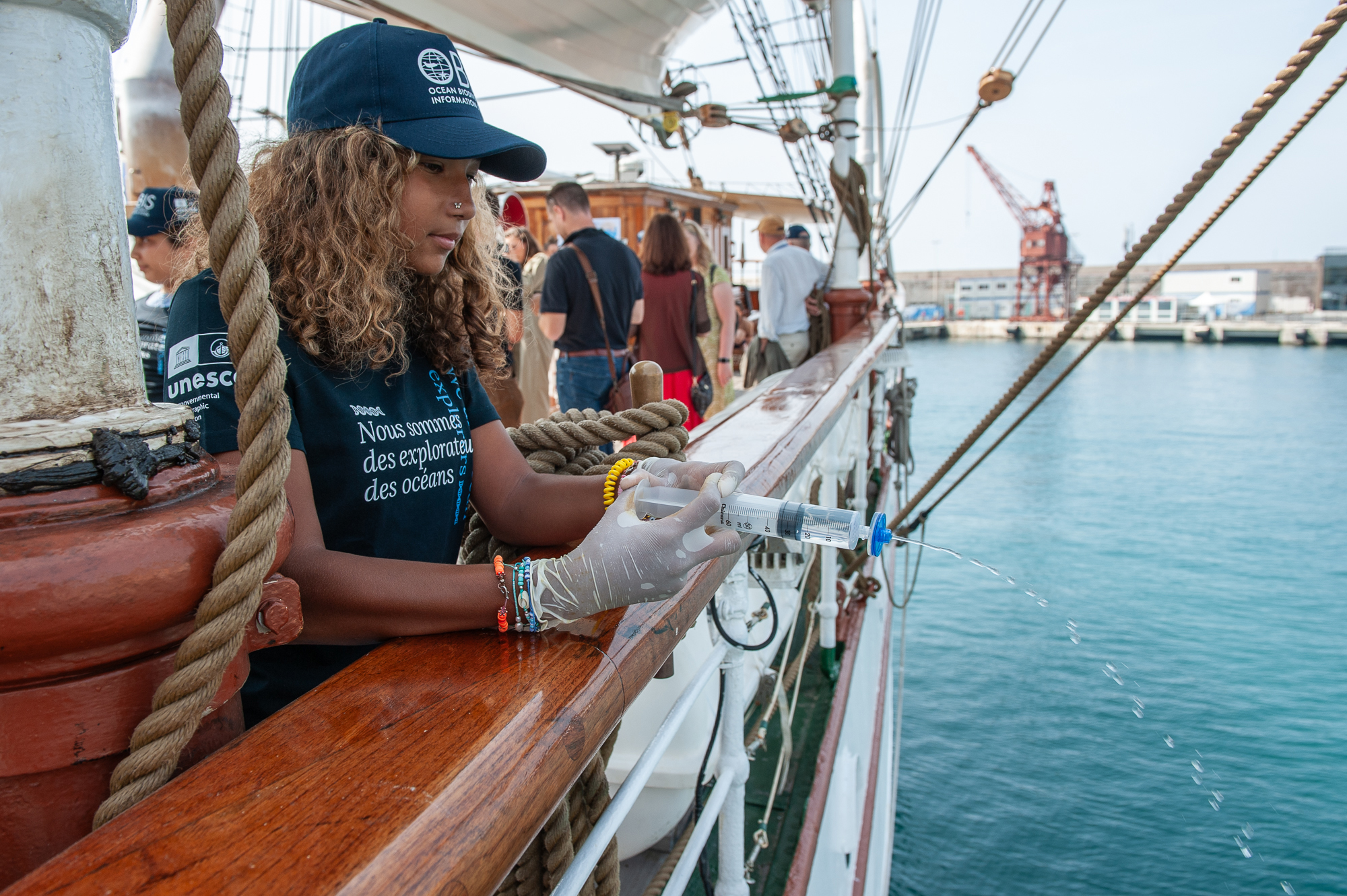 Sampling session at the lanch of the second phase of the eDNA Expeditions during UNOC-3, in the Port of Nice, France, in June 2025. Photo: RR3 Films / Richard Brives
The second phase of the eDNA Expeditions—a project under the Intergovernmental Oceanographic Commission (IOC) of UNESCO, supported by Minderoo Foundation, led by OBIS, with technical collaboration of Wilderlab—aims to build a global environmental DNA (eDNA) sampling network across 25 marine sites. All biomolecular data collected at participating sites will directly support local management as well as decision-making, and will be openly shared through OBIS. We are now inviting marine protected sites worldwide to express their interest in joining the initiative.
During Phase I of the project (2022–2024), over 250 young citizen scientists from 19 countries collected eDNA samples that revealed more than 4,000 marine species, from microscopic bacteria to whales. The experience demonstrated how powerful, efficient, and non-invasive eDNA can be for understanding marine life. Results from the first phase can be explored here.
Building on this success, Phase II will run from 2026 to 2028. This second phase shifts from a single global campaign to a longer-term monitoring effort. The project includes capacity development in biomolecular sampling, the possibility to involve local communities in the sampling events, and a rapid information loop that brings results directly back to each site to support any monitoring, management, and conservation needs.
How the project works
Selected sites will receive full technical support to run repeated eDNA surveys over the three years of the project. OBIS will provide the sampling kits and online training to guide participants step-by-step. Sampling follows a protocol that allows anyone, from experts to non-scientists, to collect scientifically valid material. All samples will be processed at a specialized biomolecular laboratory, which will generate site-specific curated species lists and biodiversity assessments. Analyses use a “tree-of-life” workflow capable of detecting biodiversity across domains, from microbes to megafauna.
From these outputs, the OBIS team will build an interactive dashboard, similar to the ones developed during Phase I, to help sites explore their results. Beyond the dashboard, OBIS will work jointly with participating sites to identify monitoring priorities and co-develop indicators that respond to local management and policy needs. All resulting data will be openly shared through OBIS in accordance with FAIR principles, contributing to advancing science and supporting policy at multiple scales.
What we ask from participating sites
To get the most out of the project, the selected sites will need to be able to commit to the whole duration of the project (2026-2028), conduct one eDNA sampling campaign every three months after following an online training, handle basic local logistics (boat access, permissions, sample collection), and engage with citizen scientists and local communities whenever possible. These activities can be easily integrated into existing local monitoring programmes and workflows.
The project team will handle everything else, including supplying eDNA sampling kits, processing samples, sequencing, building dashboards, and supporting data interpretation.
Interested in joining? Here is how to apply!
Marine sites that wish to participate in Phase II are invited to complete the expression-of-interest survey 👉 https://ee-eu.kobotoolbox.org/x/Z3km6BXB
We encourage sites to submit the survey by 15 February 2026.
For any questions, please contact the project team edna@ioc-unesco.org
More information -> https://ednaexpeditions.org/
eDNA expeditions is a project endorsed by the UN Decade of Ocean Science for Sustainable Development 2021-2030.

