News
Perspectives of an early-career scientist - A conversation with Emilie Boulanger
11 February 2026
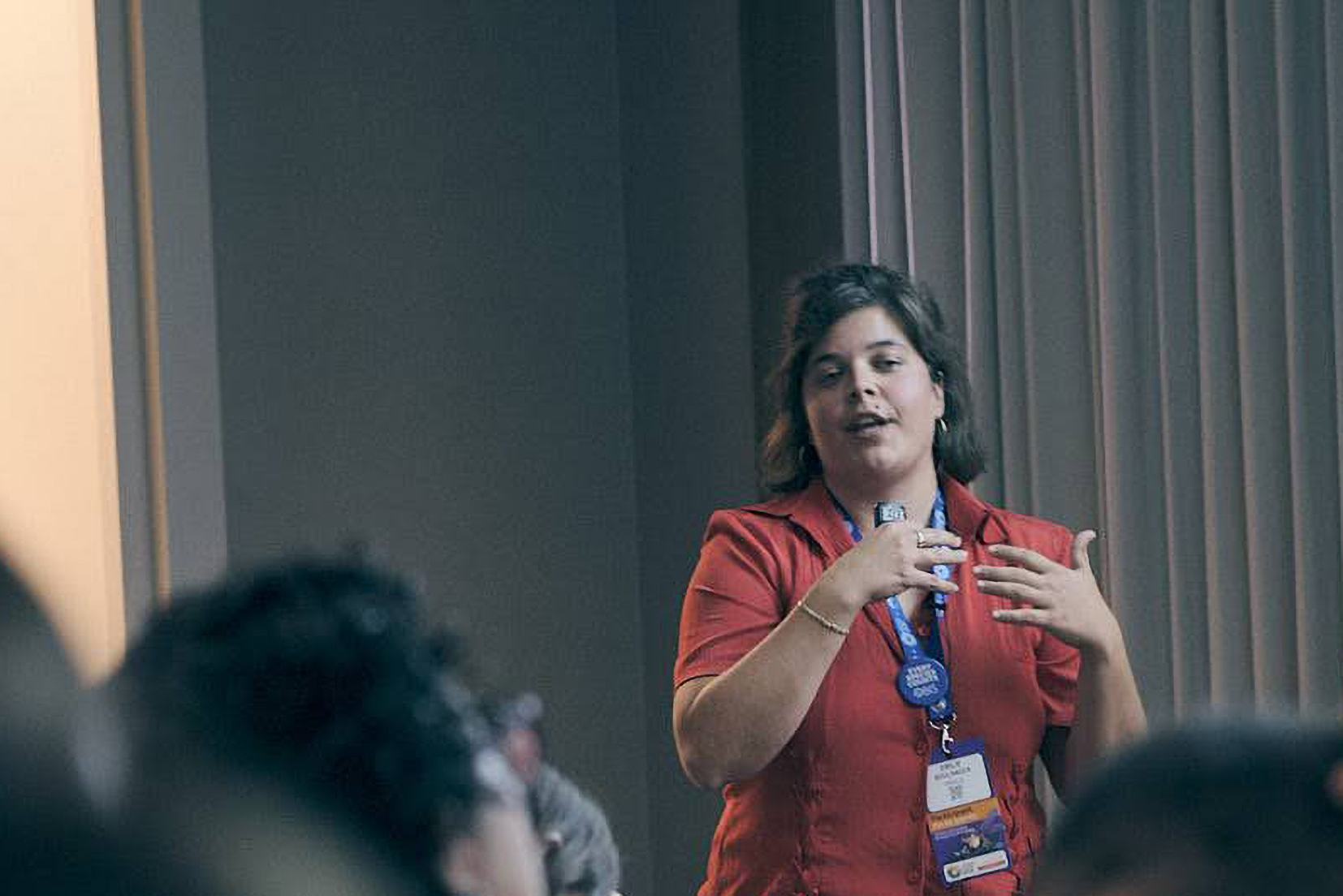 Emilie Boulanger, OBIS Scientific Officer, presenting at the Living Data 2025 Conference
For the International Day of Women and Girls in Science 2026, we sat down to discuss with Emilie Boulanger, an early-career scientist who joined the OBIS team in March 2024 as a scientific officer. Emilie is supporting the eDNA Expeditions 2026-2028, a community-driven project that aims to establish a global biomolecular observatory of 25 marine sites. Her work is at the intersection of data analysis, field implementation, and community engagement. In this conversation, Emilie shares insights on her path into marine science, her role within eDNA Expeditions, and how curiosity can be a personal driver for achievement.
OBIS: Emilie, we are delighted to have you here. Can you tell us more about your role in OBIS and eDNA Expeditions?
Emilie Boulanger: Great to be here! I work for the Ocean Biodiversity Information System (OBIS), a programme component under the International Oceanographic Data and Information Exchange (IODE) programme of the Intergovernmental Oceanographic Commission (IOC) of UNESCO, as a scientific officer specialised in DNA-based methods for biodiversity monitoring. Within the OBIS team, I work on improving the way we openly share DNA-based biodiversity data. Within eDNA Expeditions, I’ll work directly with the participating sites to co-develop the sampling strategies to answer their monitoring questions, as well as analyse and interpret the resulting biodiversity data together.
How did your journey into marine science begin? Was it something that started in childhood, or a decision you made later during your studies?
I would say a bit of both. As a kid, I was always fascinated by the underwater world. I did not grow up by the sea, but during holidays, especially in the Mediterranean, I would spend hours snorkelling and exploring beneath the surface. I got hooked, and that curiosity never left me. Now that I live close to the sea, I dive and freedive regularly, and I still love observing what happens underwater. That childhood fascination eventually grew into an actual scientific career.
Did you have a defining moment when you realised this would become your professional path?
It was not really a single epiphany, but rather a gradual process. As a child, I was obsessed with dolphins and even dreamed of working with them. Later, as a teenager, I considered studying marine biology, although at the time it felt quite distant, because it meant learning all aspects of biology, and that felt slightly overwhelming. But when the time came to choose my study path, around 18 years old, I took a leap of faith and decided to follow my instinct: I enrolled in a bachelor’s degree in biology. Learning about plants and other organisms opened my eyes to how fascinating the natural world is, and fed my curiosity for the field. Then, when I was 21, a friend told me about a Master’s degree in marine biodiversity and conservation, and I decided to go for it. And I didn’t regret this choice! Little by little, through internships, field and work experiences, my curiosity about the ocean kept growing. I’m still learning every day!
Your current role combines cutting-edge science and community engagement through eDNA Expeditions. What attracts you most to this project?
eDNA Expeditions 2026-2028 is a very unique project: it combines strong scientific work and direct engagement with people, from site management teams to local communities. We will need to work closely with all the project’s participants, make sure everyone is engaged, and receive the support they need. This is an aspect of my work that I really enjoy. Research can sometimes be quite solitary, with long hours reading articles, analysing data, and designing experiments. I am a social person, so I really value projects where science connects directly with communities and people. I am excited to dive back into field protocols and data analysis through eDNA Expeditions, while continuing to exchange directly with people about science and biodiversity monitoring. I previously held a teaching position and really enjoyed it, so I feel that I can bring a lot of community-facing skills to the eDNA Expeditions project and share knowledge while learning from the participants’ enthusiasm. Besides that teaching experience, my scientific background on community ecology of macro-organisms, such as fish, is a great match for the project. It perfectly complements the scientific background of Saara Suominen, the eDNA Expeditions 2026-2028 operational officer, who is a specialist in microbiome ecology.
The call for sites to participate in eDNA Expeditions received a large number of applications from marine sites worldwide. Were you surprised?
The project is a fantastic opportunity for marine sites, so I am really happy it piqued this much interest. The number of applications is impressive, and it is very empowering that so many people want to engage their time in it. What we offer through eDNA Expeditions is a truly collaborative process: we will co-design the observation approaches with each site, with a strong focus on flowing back the sampled data and the generated insights directly to each site. The project team aims to support each site through coordination and scientific analysis and ensure maximum uptake and mobilization of the collected data. I feel very proud to be part of that process. Being able to empower others through collaboration and knowledge transfer completely matches my values as a scientist.
You worked directly with students and teachers during the launch of the eDNA Expeditions in Nice last June. What stayed with you from that experience?
What stayed with me most was the energy I felt at that launch! We had organized an official event that was part of the UNOC programme, which included a sampling activity conducted by schoolchildren from Nice and their teacher. The students were incredibly enthusiastic and curious. The sampling was a real scientific operation and not just a vague demonstration: All the collected samples were sent for sequencing at our technical partner’s high-end lab, and we received the results back soon after. The kids were well prepared by their teacher, who had already introduced them to biodiversity and genetics concepts. The operation felt meaningful because it connected classroom learning with real-world application of DNA-derived data. These students were part of a marine-oriented curriculum, so the sampling day complemented their existing activities. Sharing that enthusiasm was incredibly motivating and deeply fulfilling.
eDNA is a cutting-edge observation technology, but you can make it more accessible using analogies. I like comparing it to crime forensics: instead of searching for human DNA at a crime scene, we look for traces of animal DNA left behind in water. And just like a crime scene may look empty, advanced techniques allow us to detect traces that are invisible to the naked eye.
As an early-career female scientist, can directly engaging with young learners as you did in Nice inspire them?
I believe it does. Growing up, I saw many incredible women teaching and working in science. Throughout my scientific career, I never questioned my place. Showing more women in scientific roles helps normalise it. It should not feel exceptional; it should simply feel natural that everyone belongs in science. In Nice, I did see some students, especially girls, take their roles very seriously during sampling. They were focused, curious, and engaged. Hopefully, it sparked something and planted a seed for the future. The ocean inspired me as a child, and that inspiration shaped my path. Seeing young people participate in community science makes me hopeful that it will foster curiosity and appreciation for nature. It may even encourage some of them to pursue careers in marine conservation.
What message would you share with a girl who is curious about science but unsure if she belongs?
Be curious, always. Keep feeding your curiosity. You belong in science, and your passion and enthusiasm will help you find, and maintain, your own path.

