News
Node Spotlight: OBIS UK, global impact from national complexity
29 May 2026
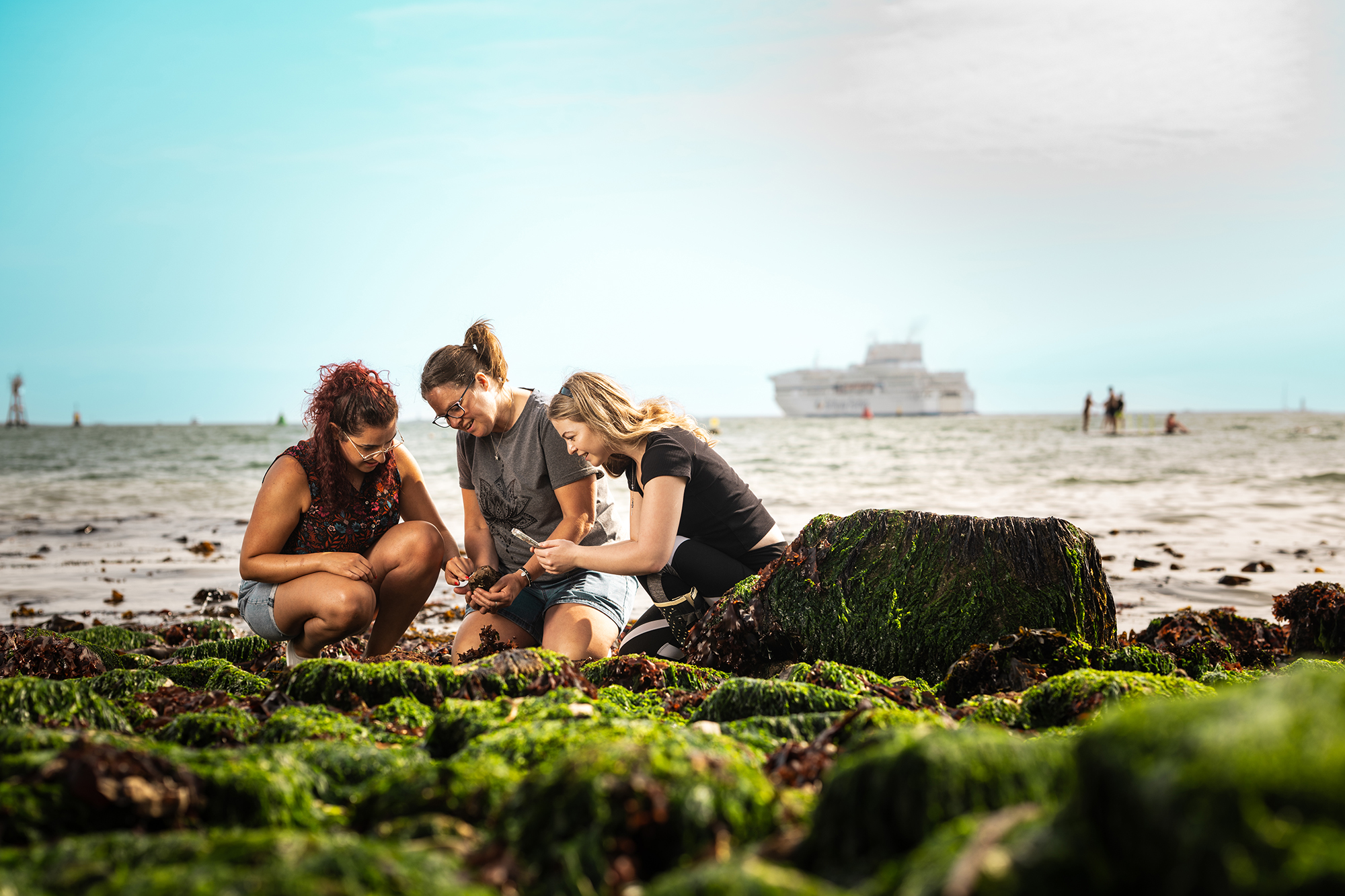
Members of the OBIS UK team recording sightings for iNaturalistUK, which flows into OBIS. Photo: Marine Biological Association
Nested in one of the world’s richest marine research ecosystems, OBIS UK plays a crucial role in ensuring that the vast amounts of data generated by national institutions get standardized, shared, published, and made globally accessible through OBIS. We spoke with Chloe Figueroa, OBIS UK Data Manager, and Emma Seal, OBIS UK Strategic Project Manager, to learn more about how the Node operates, its role within the UK data landscape, its place within the OBIS Community, and its contribution to global marine biodiversity knowledge.
OBIS: Chloe and Emma, we are very happy to have that conversation with you. For a start, could you briefly present the OBIS UK Node?
Chloe Figueroa: OBIS UK is based at the Marine Biological Association (MBA) in Plymouth, located next to the Plymouth Sound National Marine Park. The MBA itself was founded in 1884, and the OBIS UK Node has been based there since its inception in 2018. The Node has not been hosted by another organization. More precisely, the OBIS UK Node is part of the MBA Data Team, which also runs DASSH, the UK Archive for Marine Species and Habitats Data. Together, these infrastructures support the management and sharing of UK marine biodiversity data nationally and globally. The OBIS UK team is constituted of Dan Lear (Node manager and one of the Co-Chairs of the IODE Steering Group for OBIS), Ellen Jones (OBIS UK Data Officer), Kevin Paxman (OBIS UK Data Engineer), Jan Lietava (OBIS UK Junior Data Engineer), Emma Seal and myself.
How is the Node structured and funded?
Chloe Figueroa: There are eight people in the team, but not all posts are full-time. We have two Data Officers, one Senior Data Officer, a Data Manager, a Data Engineer, a Junior Data Engineer, a Strategic Project Manager, and the Head of Data and Information Technology. The team is co-funded by the UK’s Department for Environment, Food & Rural Affairs (DEFRA), the Scottish Government, and the UK Marine Environmental Data and Information Network (MEDIN). In addition, we also receive funding through projects and short-term contracts. At the moment, we are involved in two Horizon Europe projects, “Biodiversity Data for Digital Twins of the Ocean”(DTO-BioFlow) and “MARine COastal BiOdiversity Long-term Observations” (MARCO-BOLO). We also take part in shorter-term projects that come in on a more ad hoc basis, such as offshore wind data architecture mapping, facilitating the archival and publication of statutory monitoring data, supporting assessments and evaluations of marine enhancement mechanisms, and developing and delivering data management training. This support has enabled OBIS UK to develop its presence within the broader UK marine data landscape.
What motivated the creation of the OBIS UK Node?
Chloe Figueroa: OBIS UK has evolved from existing national infrastructures, particularly DASSH, which itself developed from the Marine Life Information Network, MarLIN. Before the creation of the Node, data from the United Kingdom would often remain within national systems, such as MarLIN. One of the main motivations behind the creation of OBIS UK was to ensure that data collected and managed at the national level could be shared on global platforms, such as OBIS and GBIF.
Emma Seal: There was also a broader desire within the UK marine data community to have a formal OBIS Node. Before OBIS UK existed, organizations such as the National Biodiversity Network (NBN) were already publishing marine biodiversity data to EurOBIS and GBIF, but this initiative was not coordinated through a dedicated national Node. We realized that we needed a more coherent and structured approach, where national marine biodiversity data contributions would be better integrated into the UK’s marine research ecosystem. The Marine Biological Association was encouraged to take on this coordination role, as it already had the mandate and infrastructure needed to operate at the national scale and a long-term commitment to sharing marine biodiversity knowledge.
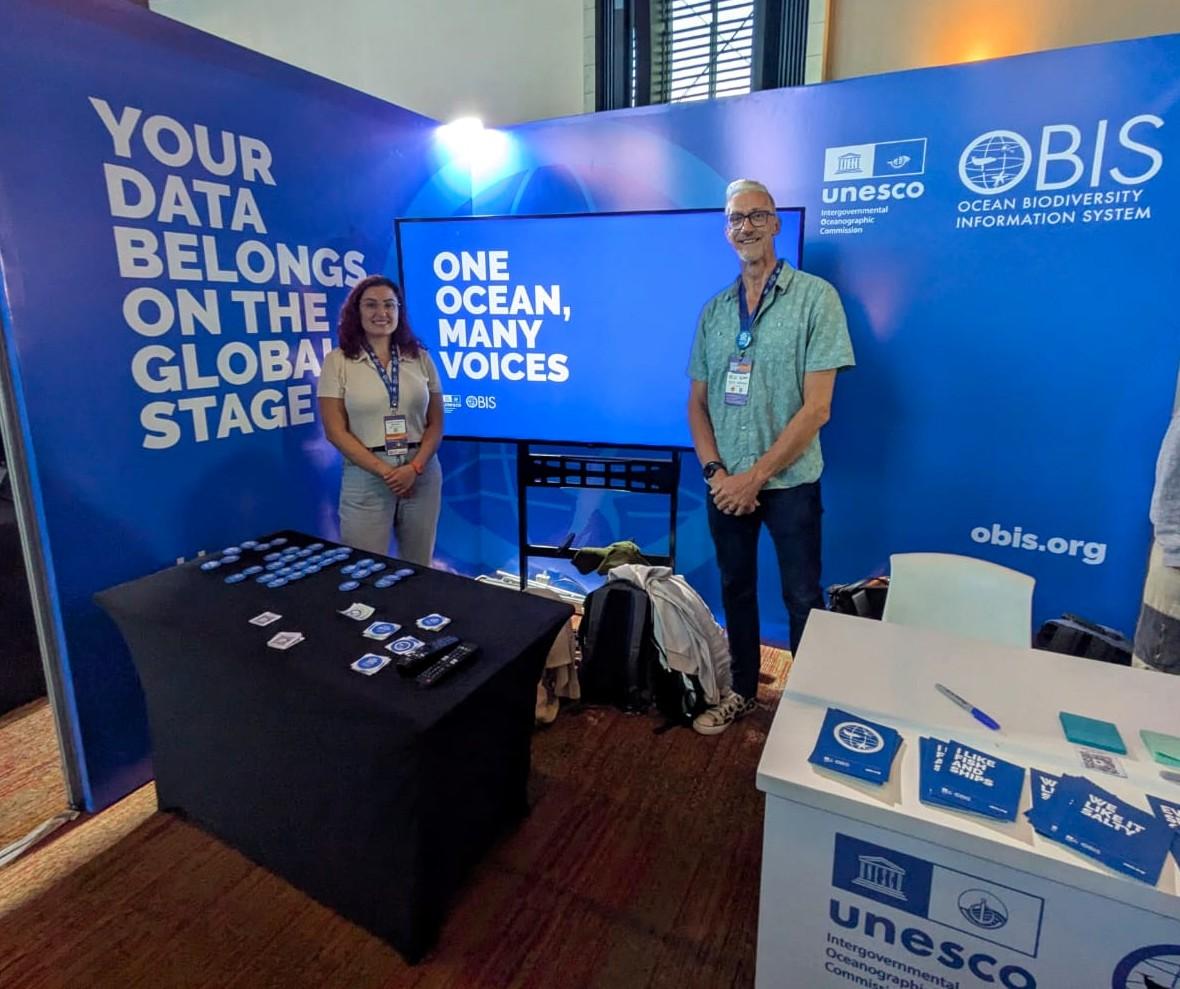
Chloe Figueroa and Dan Lear at the OBIS booth during Living Data 2025 in Bogotá, Colombia. Photo: Marine Biological Association
How does OBIS UK sit within the UK marine research ecosystem today?
Chloe Figueroa: OBIS UK directly builds on the experience, connections, and visibility of the UK Archive for Marine Species and Habitats Data. Our existing involvement in different marine communities and groups, as well as word of mouth, helped the Node to become very well-connected. The Node is recognized by institutions and communities nationally for its capacity to bring national data to the global stage and push the publication of datasets to be shared, rather than simply leaving them archived and left unused.
Emma Seal: Many of our partners already understand the value of OBIS UK, as relationships have been built over time. Discussions are often more focused on resources and efficiency, for example, how accessing standardized data through OBIS can save time and costs.
Are there still marine biodiversity communities or troves of datasets in the UK that are not yet connected to OBIS UK?
Chloe Figueroa: Yes, definitely, there are still gaps. Our recent exercises to map national marine biodiversity data flows have highlighted instances where metadata is available, but the underlying datasets themselves are not yet accessible through OBIS UK. This indicates areas where data does not complete the full journey into our node. We are currently working on facilitating these final steps. Through our work with Defra and the Scottish Government, we have targets to engage with data providers in the industry and academic sectors, as historically these data have been less accessible.
Emma Seal: This is particularly true for citizen science, the importance of which is increasingly recognized in the UK. There are many smaller projects that are not yet connected to larger systems, and sometimes very few people know about them. But overall, connections to our Node are improving. More researchers and project leaders are becoming aware of where their data should go, and they are reaching out to us. The challenge is that these projects often do not have the funding to support the full data publication process.
How do you engage with the different national communities to bring their data into OBIS UK?
Chloe Figueroa: For citizen science, we have focused on outreach by developing a best practice guidance tool for data management, published in 2024, followed by a series of workshops to increase engagement. We also directly reach out to marine citizen science projects across the UK, asking what support they need to submit their data and helping them understand where their data should go. There is one citizen science initiative where we are more closely involved: The Rock Pool Project. We have recently been working with The Rock Pool Project and a wide range of stakeholders in the UK marine citizen science space on a project funded by Natural England, which involves building out resources and platforms for the whole marine citizen science community. This work has included updates to the best practice guidance, a specific training portal with courses and resources, and a community space for exchange. As part of this, we are also involved in the development of the emerging UK marine citizen science network.
When it comes to data mobilization, whatever the community we are addressing, our approach is very straightforward: We want to reduce fragmentation and improve connections. Our engagement efforts with industry and academic groups follow that pattern of targeted support, guidance, and the establishment of clear, multi-step pathways for data integration.
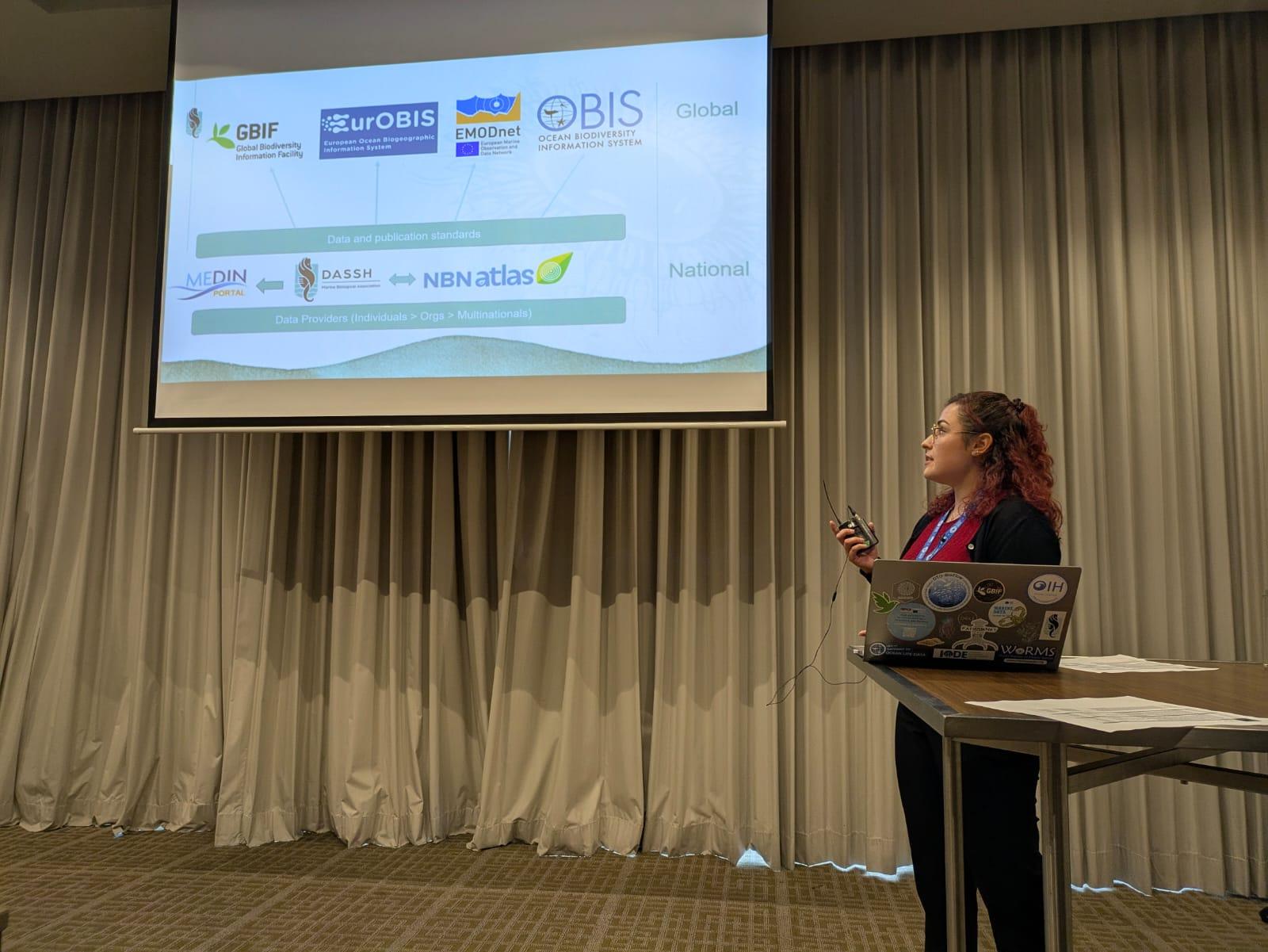
Chloe Figueroa during her presentation "From Shore to Server: Connecting Marine Civic Science to Global Biodiversity Data through DASSH and OBIS UK" at Living Data 2025 in Bogotá, Colombia.
What motivates researchers to go through the standardization effort and the global publication process?
Chloe Figueroa: Data standardization and submission to global platforms are often not planned or funded within projects. In some cases, requirements are embedded into the project’s plan. For example, the Fisheries Industry Science Partnership—a scheme which supports data collection and research for sustainable fisheries management in the UK—as well as commercial wind farm development licensed through The Crown Estate, both require the creation of metadata records as part of their funding agreements.
So we had to develop a specific strategy to boost that motivation. We noticed that explaining to data holders the benefits of publishing to global platforms worked quite well! When they understand that standardization allows their data to be reused and visible, and that their work will be acknowledged, data holders are more prone to make the effort and go through the process of publishing through us. Impact is a strong motivation! This awareness is also a focus in our work with citizen science projects.
For OBIS UK, dealing with multiple data types from so many various sources must be a huge challenge. What strategies has the Node deployed to address that issue, especially when it comes to standardization?
Chloe Figueroa: It is a collaborative process. In most cases, data providers are expected to supply their data in a standardized format, either Darwin Core or the MEDIN format. If it is submitted in MEDIN format, we convert it into Darwin Core during ingestion. The actual challenge resides in getting the submitted data in a standardized format. We provide support through workshops and one-to-one guidance to help people prepare and format their data. Where capacity allows, we also offer data standardization services for a fee. Once we get the data standardized, we can carry out quality assurance, mint a DOI, and create metadata records, all free of charge. All these services we provide accelerate the transition from local data collection to global sharing.
Has OBIS data been used to support UK marine policy or reporting?
Emma Seal: OBIS UK is regularly used as a data source to support the UK Marine Strategy. Because we operate under Open Science principles, usage tracking can be challenging. Asking users how they use data can create barriers. But at the same time, improving our understanding of data use is essential, and it influences how we share the data.
OBIS UK staff serve on several UK panels and expert groups directly linked to the statutory monitoring of the UK marine environment. Our role is to provide guidance and training in data management and ensure the data collected through monitoring activities is archived and published to support effective governance and reporting under UK, European, and international obligations.
Is there a dataset or project within OBIS UK you are particularly proud of?
Chloe Figueroa: Our first eDNA dataset, which we ingested about two years ago. It included around 600,000 occurrences and significantly increased our total number of records. That dataset presented numerous technical challenges, particularly in formatting the data into Darwin Core. To me, this project perfectly illustrates OBIS UK’s involvement in contributing to advancing marine biodiversity data standards and technologies.
Emma Seal: From a project perspective, MARCO-BOLO stands out. It is a collaborative effort focused on improving data flow and integration across organizations. It reflects the broader work OBIS UK does across projects, strengthening systems and improving the quality and accessibility of data.
Do you collaborate with other OBIS Nodes, and what does being part of the OBIS community mean to you?
Chloe Figueroa: Historically, we worked closely with EurOBIS, as UK national data flowed through it before the creation of the OBIS UK Node. Now that our national data goes directly from OBIS UK to OBIS, we mostly work together with EurOBIS on solving legacy issues. We now collaborate with other OBIS Nodes through projects, like the MARCO-BOLO project that Emma cited. Beyond these collaborations, the links with the OBIS Community are crucial. Being part of the OBIS Coordination Groups, interacting with other Nodes on technical and governance issues, shows that many of the challenges we face are shared. That is reassuring and allows us to learn from each other. It also reinforces the feeling that our work is indeed part of a greater global effort, rather than something isolated to the UK.
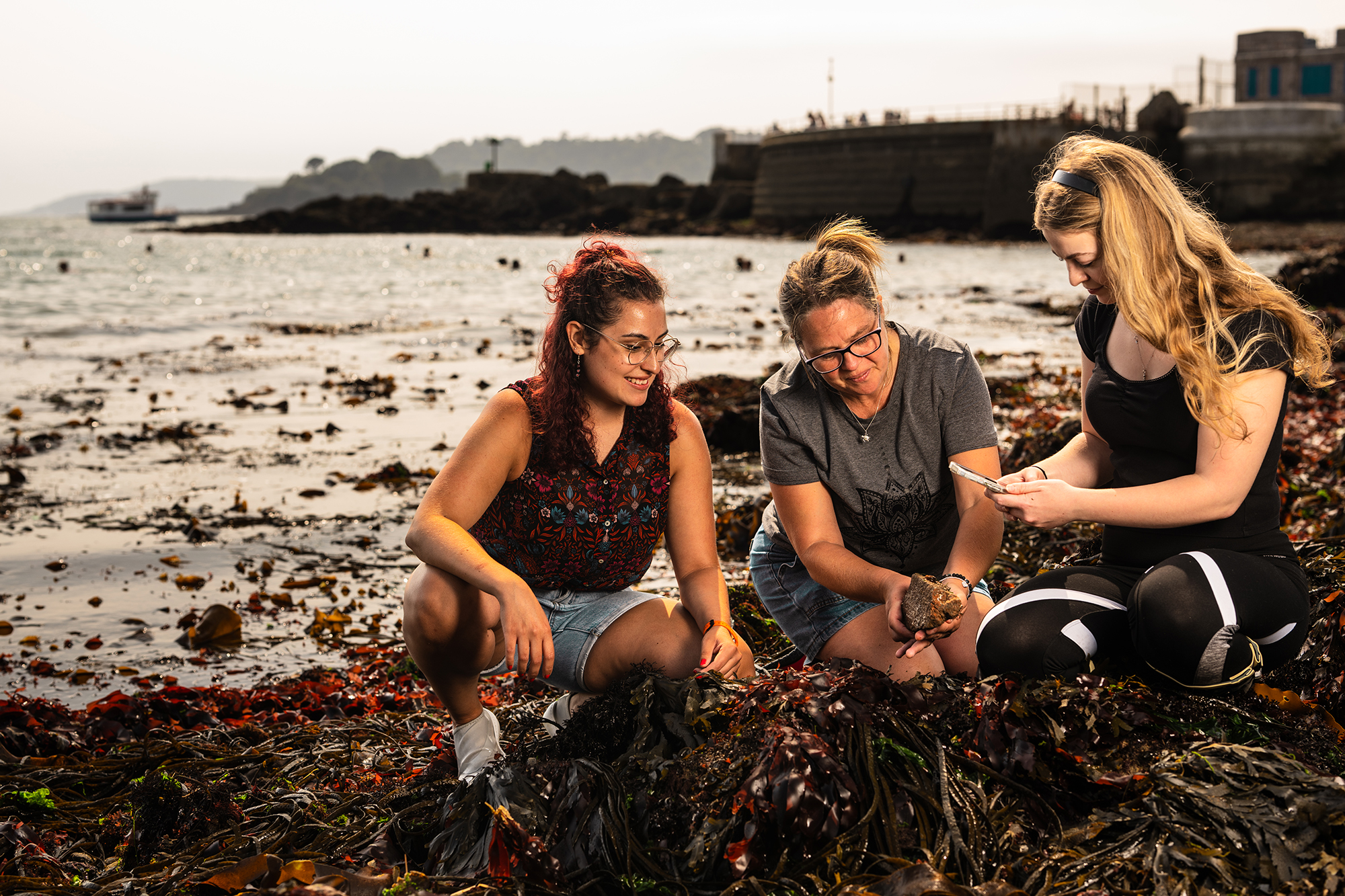
The OBIS UK team doing a rock pool survey. Photo: Marine Biological Association
OBIS: What is on OBIS UK’s horizon?
Emma Seal: We have recently renewed our core funding with Defra and the Scottish Government for the next three years, alongside continued support from MEDIN. Our focus is now on continuing to strengthen collaborations, improving data flow and quality, and supporting the UK marine data community, including with citizen science. We are also extending our expertise to new sectors in the marine environment, such as offshore wind, for example.
If you could change one thing about marine biodiversity data in the UK, what would it be?
Chloe Figueroa: I would want everyone to know where data should go. The system is complex, with many organizations and pathways. If people understood that landscape better from the start, it would improve data flow significantly.
Emma Seal: I would like a better understanding of how data is used once they are shared. This would help improve tools and processes, and help us demonstrate the real impact of the data that we share.
→ Explore all OBIS UK’s data here.
→ Find more info about what an OBIS Node is and how to become an OBIS Node, see https://manual.obis.org/nodes.html#obis-nodes

