News
Node Spotlight: OBIS Malaysia, turning Malaysia's largest marine collection into global open data
17 July 2026
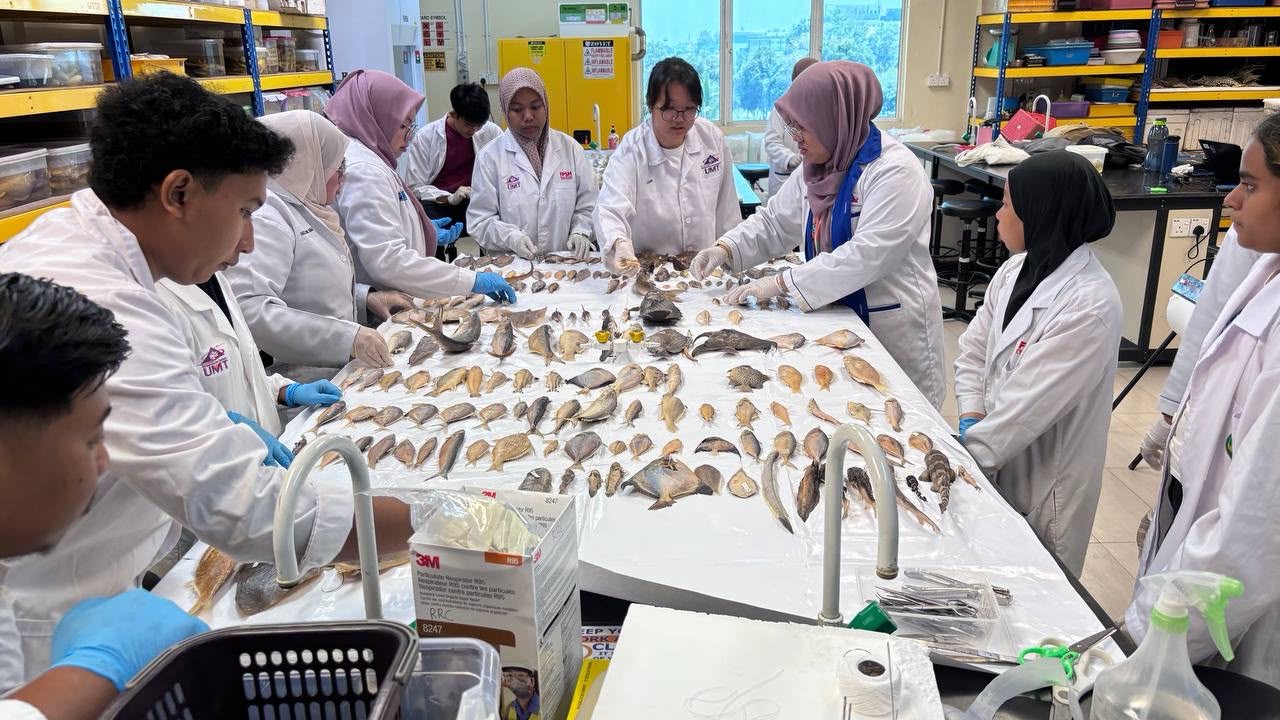
Researchers sort and identify new marine fish specimens for the Repository and Reference Centre of Universiti Malaysia Terengganu (RRC-UMT) collection, before imaging and cataloguing them. Photo: OBIS Malaysia
Operating from the Repository and Reference Centre of Universiti Malaysia Terengganu (UMT), the OBIS Malaysia Node works as a national marine biodiversity data hub that centralizes information and channels it to MyBIS, the Malaysia Biodiversity Information System, and to OBIS. We spoke with Muhammad Hafiz bin Borkhanuddin, OBIS Malaysia Node Manager, about the Node’s structure, its role in unifying the national marine data landscape, its engagement with researchers, and the opportunities that the eDNA Expeditions 2026-2028 project brings to Malaysia.
OBIS: Dear Hafiz, thank you for being here! Could you introduce OBIS Malaysia and tell us how the Node is structured, hosted, and funded?
Muhammad Hafiz bin Borkhanuddin: Thank you very much for having me. We were appointed as the OBIS Malaysia Node in 2017, under the Repository and Reference Centre of Universiti Malaysia Terengganu (RRC-UMT), formerly known as the South China Sea Repository and Reference Centre (RRC). OBIS Malaysia works closely with the National Oceanography Directorate (NOD) under the Ministry of Science, Technology and Innovation, which serves as Malaysia’s National Oceanographic Data Centre (MyNODC) within the IODE network. While OBIS Malaysia does not always collect data directly, this connection links it to marine researchers across the country. The node itself is based at Universiti Malaysia Terengganu, within the Repository and Reference Centre, functioning much like a small registry museum for the university, from which data is supplied to the global OBIS database. Much of this work is sustained through the university’s grants and operational funding.
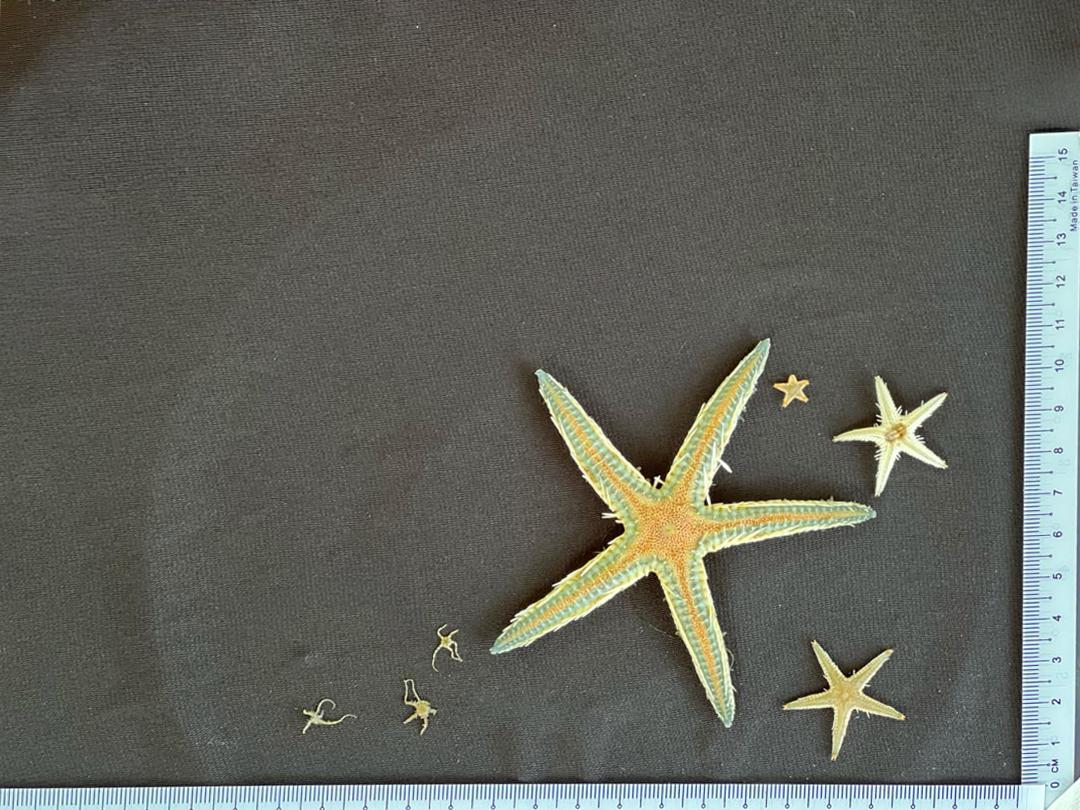
A specimen from the RRC-UMT marine benthos collection, featuring a common starfish sourced from a nearby island. Photo: OBIS Malaysia
Could you tell us who the team members behind the Node are, and what their roles are?
Muhammad Hafiz bin Borkhanuddin: I serve as the Node Manager. We also have a science officer, Mr. Ahmad Fakhrurrazi Mokhtar, acting as data manager, who handles the technical side of data ingestion and standardization before it is supplied to OBIS. We work in batches: each quarter, we identify and upload several hundred records supplied to us by various researchers and curators. Timely, we are also supported by other staff and advisors from Universiti Malaysia Terengganu, who help ensure that our operations remain aligned and at pace with the Malaysian marine science objectives.
OBIS Malaysia is very much embedded in your country’s national strategy. Is there a nationally coordinated data flow in Malaysia for marine biodiversity data?
Muhammad Hafiz bin Borkhanuddin: There is, and OBIS Malaysia, through RRC-UMT, is at the heart of it. When we publish data, we make it available at the same time in OBIS and in our national database, like MyBIS. In a way, we act as a data hub, serving both the global perspective and the national interests of Malaysia. For OBIS, of course, we focus on ocean and marine data, but on the national side, we can also cover freshwater biotopes.
In a way, we act as a data hub, serving both the global perspective and the national interests of Malaysia.
What motivated the creation of OBIS Malaysia?
Muhammad Hafiz bin Borkhanuddin: Malaysia’s marine biodiversity data landscape was, for years, extremely fragmented: institutions held onto their own data, building silos that locked crucial biodiversity information away from one another. This was an urgent problem to solve for Malaysia’s identity as a maritime nation, whose marine area exceeds its landmass and stretches across 4,675 km of coastline along the Strait of Malacca, the South China Sea, and the Sulu-Celebes Sea. It was this urgency that had already driven Universiti Malaysia Terengganu, back in 2004, to establish the South China Sea Repository and Reference Centre (RRC) as a dedicated home for the country’s marine specimens, filling a gap left by the absence of any centralised institution. But it was a stronger, national-level political impetus that eventually changed the trajectory: Malaysia built MyBIS to centralise its biodiversity data flows before global publication, and OBIS Malaysia was born directly out of that ambition. The Node was designed to serve as the mechanism to accelerate marine data centralisation through MyBIS, while positioning Malaysia as a global contributor to marine biodiversity science. RRC, having already earned recognition as a Higher Institution Centre of Excellence, an IODE Associate Data Unit, and the host of a Regional Training Centre under the Intergovernmental Oceanographic Commission (IOC) of UNESCO’s OceanTeacher Global Academy, was the natural candidate to carry that ambition forward. It became the OBIS Malaysia Node in 2017, and became Malaysia’s global gateway for nearly two decades of Malaysian institutional groundwork.
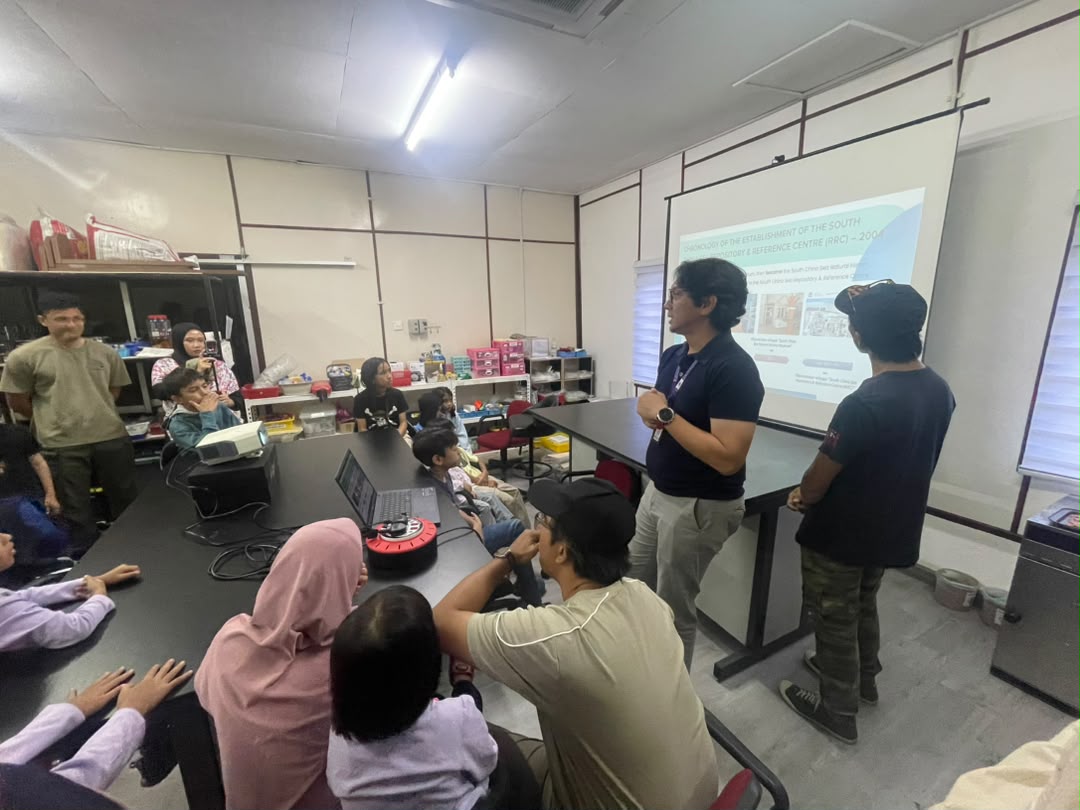
Citizen scientists visiting the RRC-UMT laboratory and gallery to learn essential techniques in specimen preservation and data recording. Photo: OBIS Malaysia
Now that you hold this central position as an OBIS Node Manager, where are the strongest data flows in Malaysia, and where are the biggest gaps?
Muhammad Hafiz bin Borkhanuddin: Before answering your question, allow me to thank my predecessor as Node Manager of OBIS Malaysia, Assoc. Prof Dr. Izwandy Idris, who laid out the solid foundations on which I’m now developing the Node. Back to the question: our main issue is the speed of biodiversity data entry into our national platform. This is where the main bottleneck and, of course, our main backlog are. Part of the solution would be to improve the platform itself: we would greatly benefit from a more advanced, integrated data management system than the one we have now. We have a very large amount of data, hundreds of thousands of records, and all of it needs to be integrated, keyed in, and then transferred to the platform. The other part of the solution to tackle that bottleneck is to increase our publishing capacity and human resources.
Does this backlog data sit in paper logs, or is it digital data that is still awaiting processing?
Muhammad Hafiz bin Borkhanuddin: It is a bit of both. We have institutional data in paper catalogues and historical data that still needs to be digitized. We also have data that is already digitized, but that still needs to be verified and curated before it goes to the next level. Before we pass anything to OBIS or to MyBIS, all that data has to be thoroughly checked. And that is one of the reasons for the current bottleneck: We need to treat a very large number of records with very limited resources… And new data is continuously coming in!
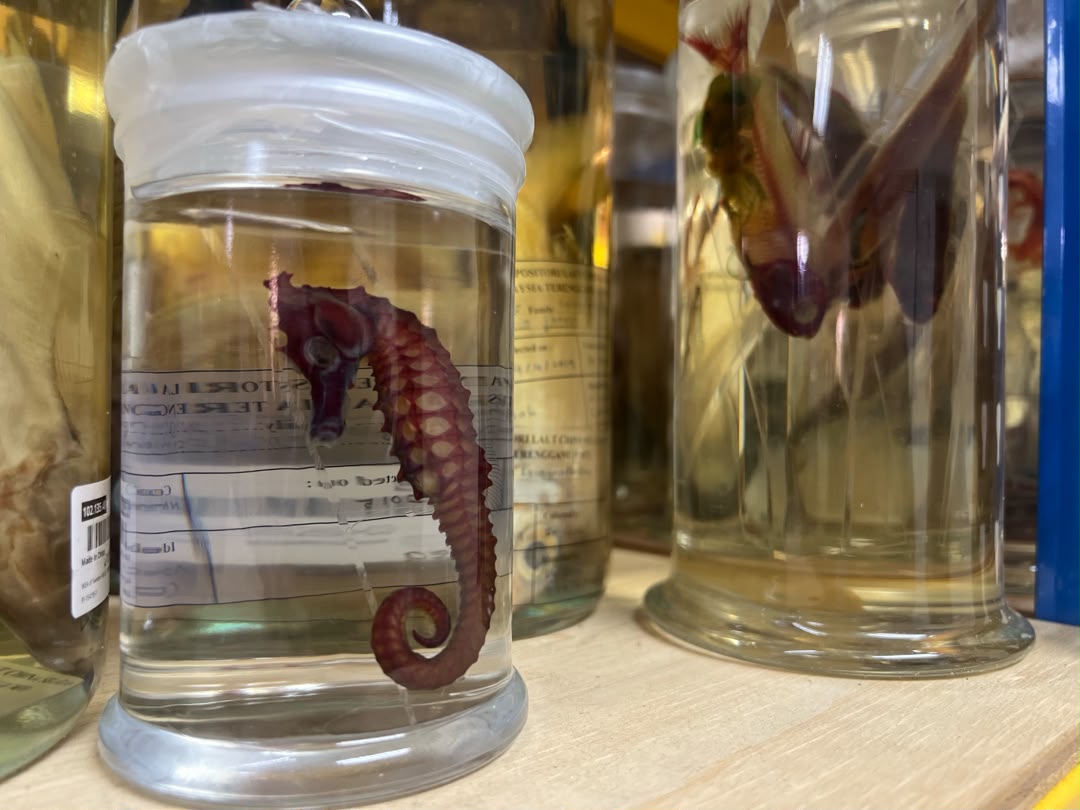
A stained seahorse preserved at the RRC-UMT. These specialized specimens are utilized for teaching, learning, and various zoological studies. Photo: OBIS Malaysia
What are the main obstacles that Malaysian marine researchers face when they want to publish their data, and how does OBIS Malaysia support them?
Muhammad Hafiz bin Borkhanuddin: I think OBIS is not known enough among marine researchers in Malaysia yet, and I want to change that. We need to raise awareness among Malaysian data providers to make them understand that they, too, would benefit from unlocking the marine biodiversity datasets they hold and sharing that data while contributing to a national scientific effort. On that front, I think a consortium-based approach would work: a roadmap, something cohesively agreed upon between universities and institutions in Malaysia involved in marine research, so that they would naturally turn their data to OBIS Malaysia. But again, it’s a bit of a balancing act here: if we are too efficient in our awareness, and if too many people from these institutions contribute, we come back to the challenge of human resources for data curation, verification, and even, in some cases, digitization!
How do you engage with these different national communities, universities, and institutions?
Muhammad Hafiz bin Borkhanuddin: We have not yet held formal meetings or even a congress with Malaysian marine researchers. We have engaged with some of them, more on a personal basis, or because the opportunity arose. Usually, I introduce OBIS when opportunities arise, explain how they can contribute, speak to them about OBIS, explain why they should contribute, and how they can contribute. But it would be much more effective if I could invite all the marine researchers in Malaysia to a meeting and explain why it is our national interest to contribute to OBIS. The OBIS Malaysia Node could be better integrated and more synergized with our marine researchers, so that eventually more data can be channelled to MyBIS and OBIS. But again, organizing such a congress requires human resources and, of course, funding.
Are newer data types, such as environmental DNA (eDNA), acoustic monitoring, or imagery, starting to come into OBIS Malaysia?
Muhammad Hafiz bin Borkhanuddin: eDNA is not entirely new to Malaysia; the method has been used both for marine and freshwater environments for a while now. But it is becoming more popular and generating more interest. Researchers now want to integrate eDNA with physical data and with other biological research. We are also seeing work on AI for marine benthic monitoring and environmental profiling. Researchers are using photogrammetry and training AI to classify the benthic environments or organisms they observe. It is still a rough start, but a promising one that progresses fast. Another important development for us is data sharing on the cloud, with platforms such as Coral Reef Cloud engaging people around the world. These are all very positive developments, but they are also moving quickly, so we have to keep up with the technologies to stay on the same path as research happening elsewhere in the world.
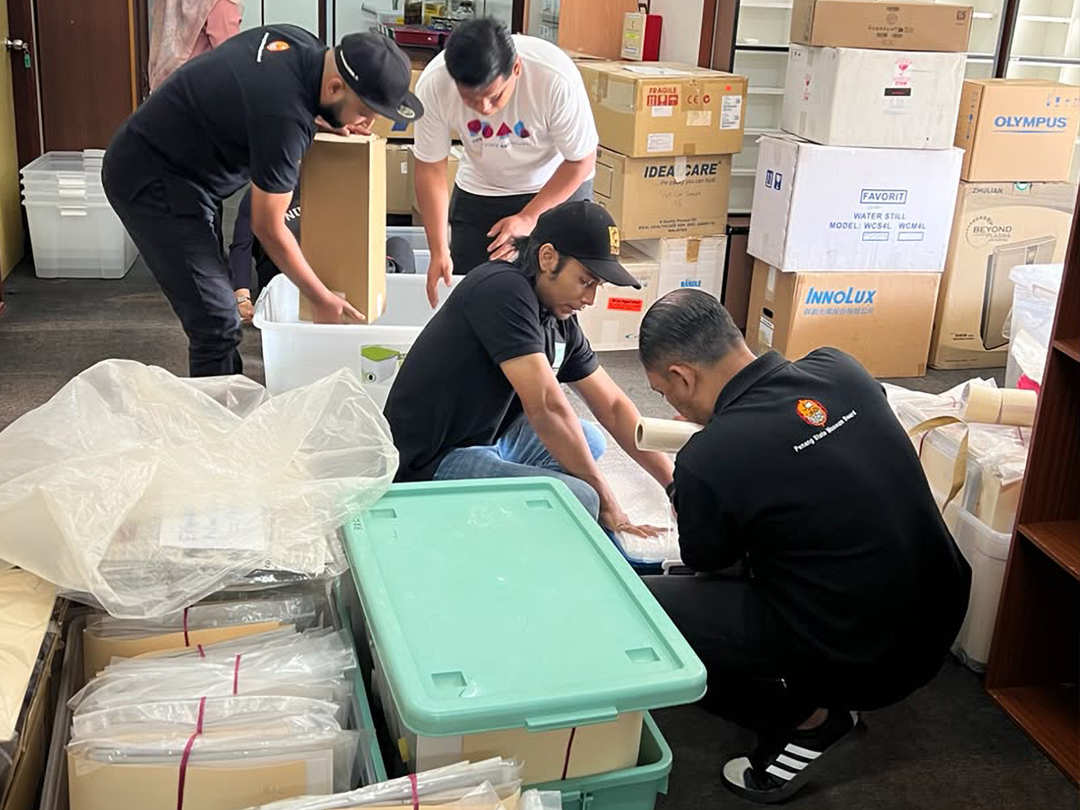
Preparation and transport of marine specimens from the RRC-UMT collection before their loan to a local museum for display in their public gallery.
OBIS Malaysia is closely involved in one of the sites selected for the eDNA Expeditions project. What does this participation in the project bring to the Node?
Muhammad Hafiz bin Borkhanuddin: For OBIS Malaysia, it is a fantastic opportunity to gather more and different kinds of data and information from the Terengganu marine ecosystems that will enhance the physical observations we have collected previously. Being part of eDNA Expeditions will also serve as a strong promotional use case that other researchers in Malaysia could replicate. And that’s a huge added value for us at a national level. Through the project, we co-created a very structured science plan, and we have access to an easy-to-follow sampling protocol that can be implemented anywhere in Malaysia. We really appreciate that the approach in eDNA Expeditions 2026-2028 is so hands-on: At Terrenganu, during the project, we plan to involve research institutes, governmental institutions such as the Department of Fisheries and Marine Park officers, and local communities and stakeholders, including dive and boat operators. Through OBIS Malaysia, we will also connect our site to regional initiatives, such as the Coral Triangle Initiative and the working group on the coastal and marine environment, and promote the eDNA Expeditions concept and framework to our regional counterparts.
Being part of eDNA Expeditions will also serve as a strong promotional use case that other researchers in Malaysia could replicate.
Do you have examples of data from OBIS Malaysia that were used to support national or regional marine policy or reporting?
Muhammad Hafiz bin Borkhanuddin: For us, this is really about closing the gap between data and decision-making. Marine biodiversity datasets only become valuable once they’re translated into something governments and ministries can actually act on, whether that’s a conservation action plan, a coral reef management policy, or a longer-term marine resource strategy. Our team has been directly involved in this kind of work at both state and national levels, contributing data toward conservation planning and coral reef policy development. But the specifics matter less than the underlying principle: as scientists, our responsibility is to make sure the data is ready and accessible before it’s needed, not after. In Malaysia, that means fundamental biodiversity datasets have to be published and maintained in a form that can be mobilized by decision-makers without friction. I’d say this science-policy interface is really one of the core reasons OBIS and its nodes exist: ensuring that decision-makers are aware that the data exists, and that they can make use of it.
Is there a dataset or a project within OBIS Malaysia that you are particularly proud of?
Muhammad Hafiz bin Borkhanuddin: Without question, the Repository and Reference Centre, where my team and I are based. We hold the largest collection of marine specimens in Malaysia, containing more than 100,000 registered specimens, with another substantial batch still in our backlog awaiting verification and curation. This collection is a living resource: Through these specimens, we support marine researchers across Malaysia in running their projects and publishing their findings, and we open our doors to international partners and collaborators who come to work with our collection. Building something researchers actually rely on, year after year, is what I’m most proud of, and I hope we can keep growing it. The other achievement I would highlight is that Terengganu State Park has been selected to take part in the eDNA Expeditions project. It brings cutting-edge environmental DNA technology into our local waters, and suddenly a very localised stretch of Malaysian coastline is placed on a global scientific map, connected directly to a worldwide platform for ocean knowledge.
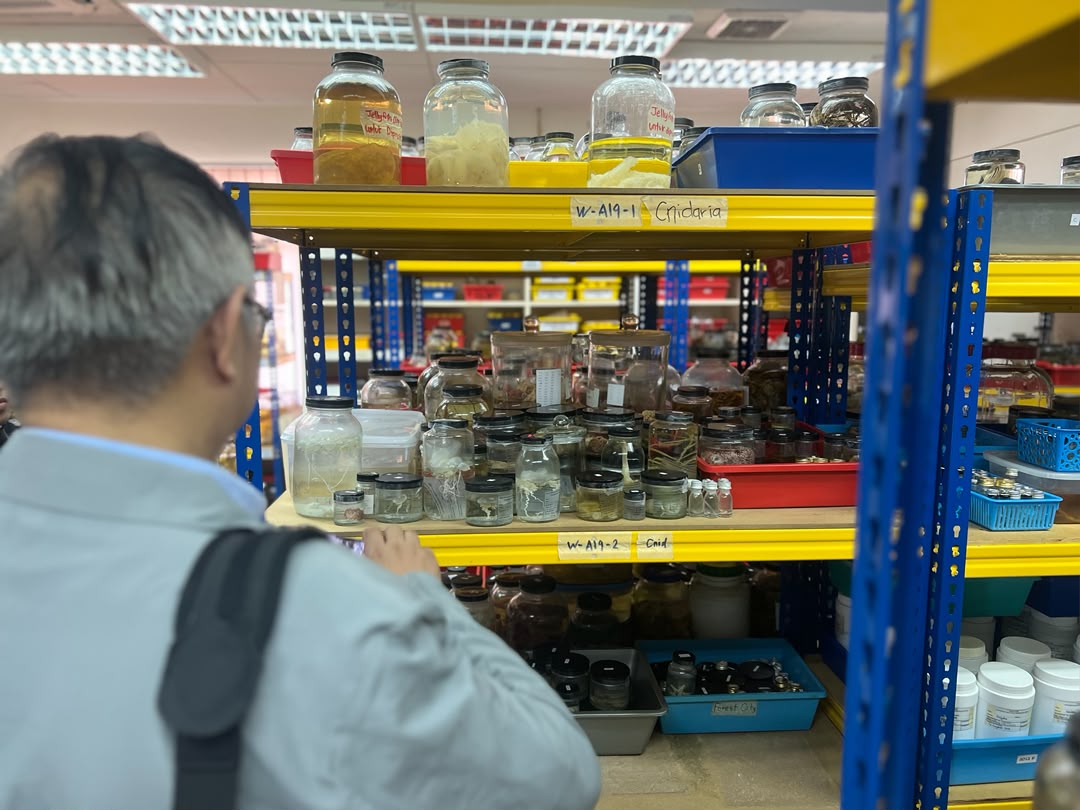
International guests touring the extensive collection room. The facility houses approximately 300,000 natural history specimens, ranging from wet and dry biological samples to geological and paleontological materials.
What does being part of the OBIS community mean to you?
Muhammad Hafiz bin Borkhanuddin: Being part of the OBIS community is very informative and beneficial. Through meetings, I’m aware of what other OBIS members are doing in their regions, and I know that I have a community that can back me up if I have a question or an issue. That is the beauty of the OBIS community: we run different activities, but we share the same aim of promoting marine research and data sharing to the global arena. At OBIS Malaysia, we are happy to help and assist other Nodes wherever we can.
What is on the horizon for OBIS Malaysia in the coming years? Are there big changes or investments you are looking forward to?
Muhammad Hafiz bin Borkhanuddin: As I mentioned, reaching out to more marine researchers in Malaysia is one of the things we want to focus on, so that data sharing becomes more cohesive and better integrated through MyBIS and OBIS. At a very personal level, I am really looking forward to effectively starting to carry out the sampling work under eDNA Expeditions. I know that this project will open a lot of opportunities for OBIS Malaysia and for the country: we do need to build up capacity in the whole DNA-derived data chain, from setting up bioinformatics pipelines to learning how to process the data and make full use of it, so that eDNA observations become more sustained in Malaysia. That’s a long-term vision! ◼️
→ Explore the OBIS Malaysia Node page.
→ Discover MyBIS, the Malaysia Biodiversity Information System

