Innovation & Emerging Technologies
OBIS integrates new frontiers like eDNA, artificial intelligence, and imaging, scaling up biodiversity monitoring and discovery. As both a beneficiary and a driver of technological innovation, OBIS provides the taxonomic and geographic reference framework against which emerging observation methods are calibrated, while making novel data streams globally accessible and interoperable with decades of historical records.
Supports: UN Ocean Decade, KMGBF Target 20
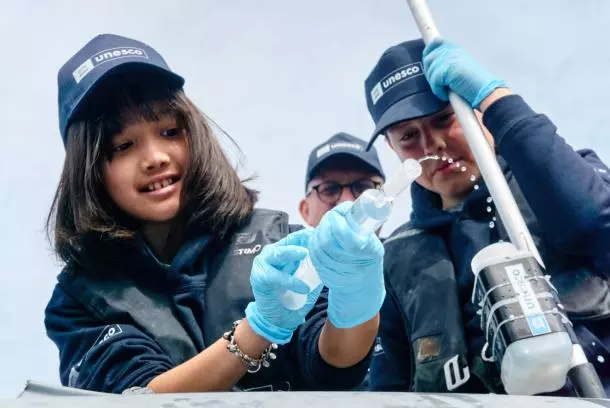 Metabarcoding is a promising tool for identifying species of fish from their environment — a study demonstrating how molecular techniques integrated with OBIS expand the scope of marine biodiversity monitoring.
Making molecular biodiversity data interoperable with the global occurrence record
Implemented
OBIS has developed Darwin Core extensions for DNA-derived data and established publishing guidelines for eDNA datasets, creating the technical infrastructure needed to incorporate molecular observations alongside traditional occurrence records. These standards are now used by a growing number of research projects worldwide.
Region: Global
Challenge/issue: Molecular biodiversity data from eDNA and metabarcoding studies is generated in formats incompatible with traditional occurrence databases, preventing integration with decades of historical records.
Impact: A growing body of molecular occurrence data published through OBIS in standardised formats, enabling comparison with traditional survey data and expanding the scope of biodiversity monitoring.
OBIS inputs: Darwin Core DNA-derived data extensions, OBIS publishing guidelines, OBIS occurrence infrastructure
Translating species distribution models into actionable tools for non-specialist audiences
Implemented
OBIS occurrence data underpins a suite of model-based decision-support tools, including the Species Distribution Maps platform developed within MPA Europe, which uses machine learning approaches to generate spatially explicit biodiversity projections accessible to non-specialist audiences.
Region: European seas
Challenge/issue: Species distribution modelling outputs are typically inaccessible to the managers and policymakers who most need them, remaining locked in scientific publications or requiring specialist software to use.
Impact: An openly accessible decision-support platform translating OBIS-based models into spatially explicit projections usable by MPA planners without specialist skills.
OBIS inputs: OBIS occurrence data, species distribution modelling outputs, OBIS API
Deploying eDNA-based biosecurity monitoring in operational marine management
Implemented
The PacMAN project developed an end-to-end bioinformatics pipeline linking field eDNA sampling, laboratory sequencing, automated taxonomic assignment, and data publication to OBIS — demonstrating how emerging molecular technologies can be integrated into operational marine biosecurity monitoring.
Region: Pacific Island States
Challenge/issue: Conventional morphology-based biosecurity monitoring is slow, expensive, and requires specialist taxonomic expertise that many island states lack — creating critical gaps in early warning for invasive species.
Impact: An operational, reproducible eDNA biosecurity pipeline deployed in Pacific island ports, providing rapid species detection linked to OBIS biodiversity baselines.
OBIS inputs: OBIS baseline occurrence data, World Register of Introduced Marine Species, OBIS publishing infrastructure

